
Criminal Court Cases in Adams County
The Iowa District Court for Adams County hears felony, misdemeanor, traffic, and other state trial matters. Iowa does not divide these cases between a separate county criminal court and a city municipal court. That unified structure matters. A simple misdemeanor arising in Corning and an indictable offense from rural Adams County can both produce records within the District Court system, though their procedures and charge levels differ.
The Clerk of District Court is custodian of the local file. The clerk maintains the docket, filed charges, motions, orders, financial entries, judgments, and sentencing material. The County Attorney prosecutes state charges, while the judge decides motions, pleas, trial issues, disposition, and sentence. Sheriff records may explain an investigation or arrest, but they do not replace the court file. For an arrest-to-charge comparison, the county's arrest search information explains why booked allegations and filed counts may not match.
Adams County in Iowa Courts Online
Iowa Courts Online is the statewide discovery route for an Adams County docket. Its public interface supports name and case searches, county narrowing, and case-type filters. Results may show the case number, filing date, party role, status, charge entries, hearings, financial obligations, and a chronological event list. A matching name is only a lead. Confirm the county, case number, middle name when shown, and charge details before treating two records as the same person.
The manifest image from the official Iowa Courts Online search shows the government portal used for Adams County case discovery.
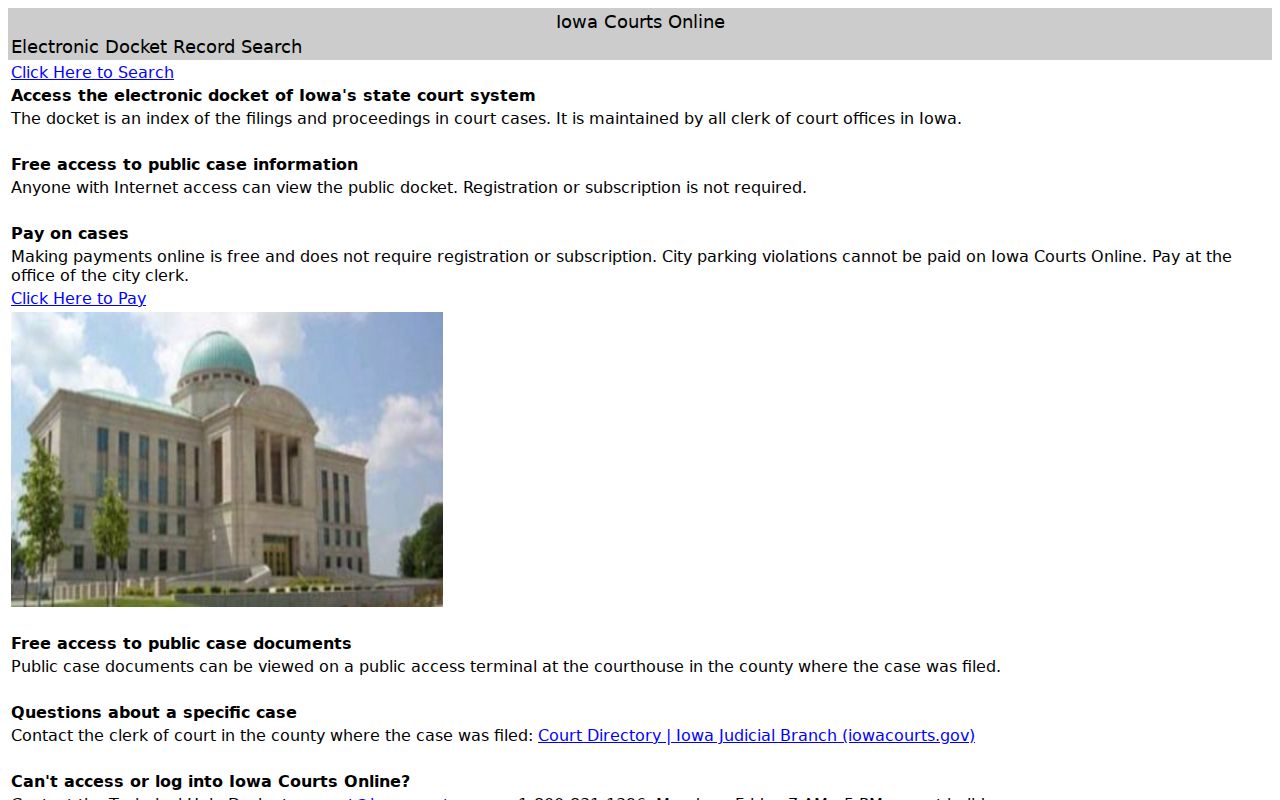
The screen is a starting index, not a promise that each filing can be opened or that every restricted matter will appear.
Adams County Case Record Searches
Use the most exact identifier available. A case number is more reliable than a name, while a county filter reduces matches from elsewhere in Iowa. Search both criminal and traffic categories when the filing type is uncertain. After opening a summary, read each count and its disposition. Do not rely on the overall status alone, since one case can contain several counts with different results.
- Open Iowa Courts Online and choose a case-number or party-name search.
- Enter the case number when known, or use the person's legal first and last name.
- Select Adams County and the relevant criminal or traffic case type; add a date range if the interface offers one.
- Open the summary and compare charges, docket events, scheduled hearings, financial entries, and count-level outcomes.
- Ask the Clerk of District Court for unavailable, older, complete, or certified documents.
The fields can change, but the official research captured the following common controls:
| Field Label | Type | Required | Notes |
|---|---|---|---|
| Case Search / Name Search | Mode | One mode | Choose an identifier or party search |
| Case Number | Text | No | Best unique key; keep shown punctuation |
| Last and First Name | Text | Conditional | Use legal spelling; add first name to narrow |
| Middle Name | Text | No | Helps resolve common-name matches |
| County | Dropdown | No | Select Adams for local results |
| Case Type | Dropdown | No | Criminal and traffic may be separate |
| Date Range | Date fields | No | Narrows filings or events when offered |
No Adams County Municipal Court
Searching for a Corning, Prescott, or Nodaway municipal criminal docket leads to a dead end because those cities do not operate separate municipal court portals. Iowa's unified District Court structure places filed local offenses in the same state court system used for the rest of Adams County. The proper online filter is Adams County, not a city court name. This distinction also keeps readers from mistaking a city clerk, community center, or county administrative office for the Clerk of District Court.
The official Fifth Judicial District page provides the larger court-administration context for Adams County.
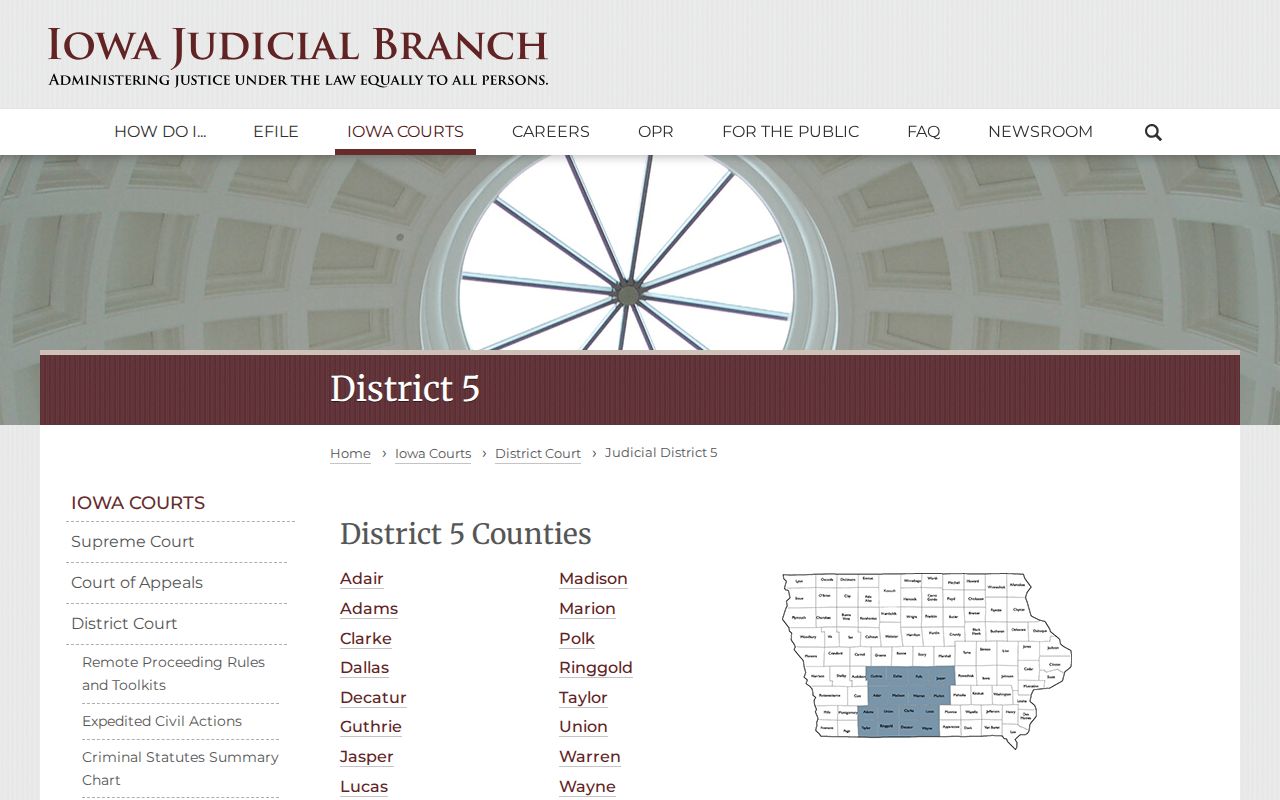
That district route confirms that Adams County cases belong within Iowa's Fifth Judicial District rather than a stand-alone city system.
Note: A city named in an incident does not change which Adams County clerk holds the filed criminal case.
What a Criminal Case File Contains
A criminal file is organized around a court case, not just an arrest. The charging instrument identifies what the prosecutor filed. Later entries record appearances, pleas, motions, orders, trial activity, and the outcome of each count. Financial sections may show fines, court costs, restitution, and payment status when public. The docket description can also identify a document even when the public portal does not provide the document itself.
| Case Number & Court | The unique case identifier, Adams County venue, court type, filing date, and status. |
|---|---|
| Charging Document | The complaint, trial information, or indictment stating the prosecutor-filed counts and Iowa Code citations. |
| Docket Entries | A dated register of filings, appearances, motions, orders, pleas, warrants, and later court action. |
| Hearing Dates | Scheduled event type, date, time, and location or judicial officer when publicly shown. |
| Disposition & Judgment | The outcome of each count, such as conviction, dismissal, or acquittal, plus the judgment. |
| Sentence & Conditions | Confinement, probation, financial terms, restitution, and other public orders imposed after judgment. |
Protected identifiers are redacted. Juvenile, sealed, expunged, and other confidential records do not become public because a search was attempted.
Adams County Clerk File Retrieval
The clerk's criminal records counter is at the Adams County Courthouse, 500 Ninth Street, Corning, Iowa 50841. The court contact listed in the research is 641-322-4711, fax 641-322-4523, and countyclerk.adams@iowacourts.gov. For an older or non-digitized case, give the approximate year, full legal name, and charge. Staff can then identify the file and explain retrieval, copy, or certification options. Confirm counter hours and any current copy fee before making a special trip.
The official Adams County clerk information is the source to check for current court contact and access details.
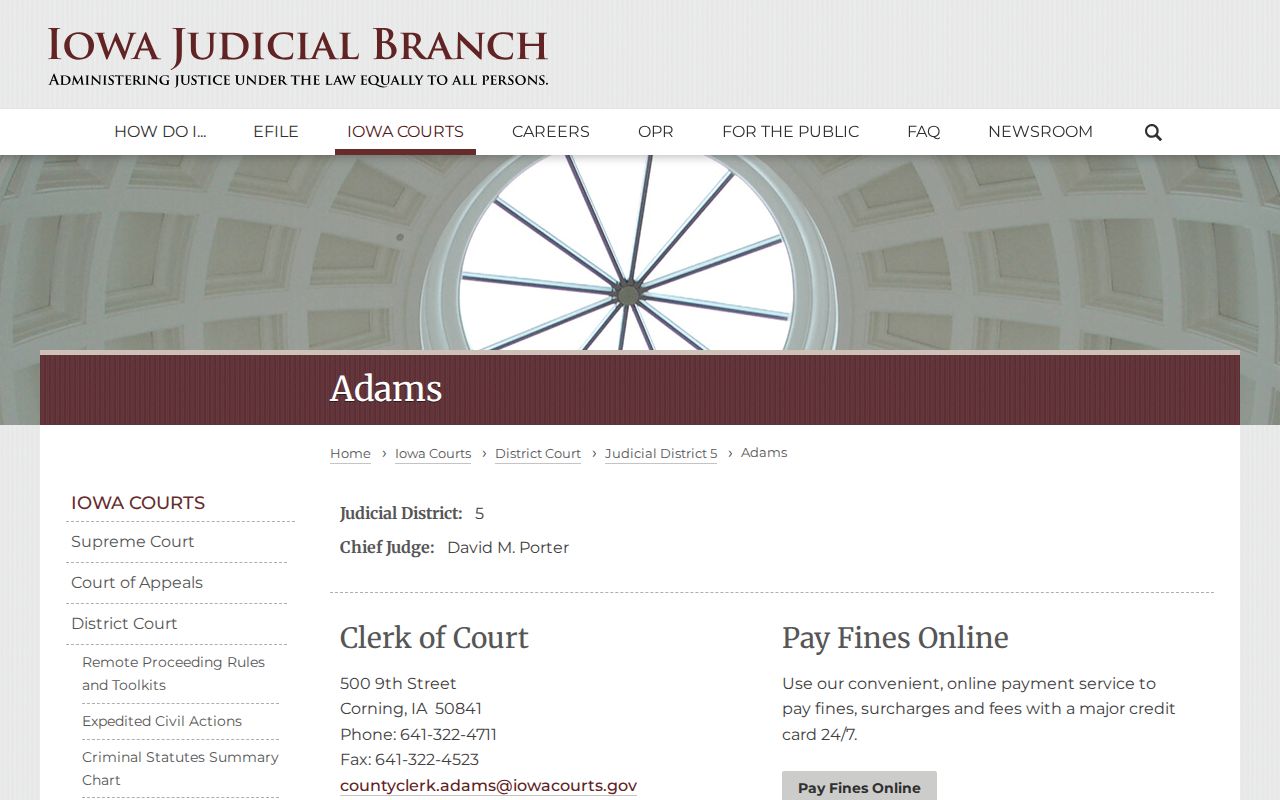
The clerk route matters when a docket line is visible but its underlying filing is not available as a public download.
Clerk of District Court
Adams County Courthouse
500 Ninth Street
Corning, IA 50841
641-322-4711
Files, copies, certification, court costs, and docket questions.
Criminal Case Stages in Adams County
A sheriff investigation or arrest may be followed by a prompt initial appearance. The County Attorney reviews the referral and may file a complaint, trial information, or pursue an indictment for an indictable offense. Arraignment addresses the charge and plea. Discovery, motions, and negotiation follow. The matter then reaches a plea or trial, a count-level disposition, and, after conviction, judgment and sentencing. Probation, appeal, or postconviction action can add later entries.
Case flow: Charges Filed › Arraignment › Pretrial › Plea or Trial › Disposition › Sentencing
The arresting charge can differ from the filed or final charge. Dates and entries, not assumptions about a routine timeline, show what happened in one Adams County case.
Adams County Count-Level Outcomes
An overall case status can hide important differences. One count may be dismissed while another ends in a guilty plea. A charge might be amended to a different Iowa Code section, and the disposition attached to the old count may not describe the final judgment. Read the count number, original and amended descriptions, severity, disposition date, and sentence together. “Disposition” means the result or current resolution of a charge; it does not always mean conviction.
- Trial information
- An Iowa prosecutor's formal charging instrument for an indictable offense.
- Arraignment
- The court proceeding where charges and the defendant's plea are addressed.
- Dismissal
- The end of a charge without conviction on that count.
- Deferred judgment
- An Iowa outcome that withholds judgment subject to conditions; it is not the same as no filing.
Financial entries need the same care. Fines, surcharges, court costs, and restitution are distinct items, and a payment balance does not by itself state the criminal outcome.
Access Rules for Case Records
Iowa court access begins with the presumption that public records may be examined, but specific laws and court rules protect confidential information. Iowa Code chapter 22 supplies the general public-record framework. Juvenile matters receive separate protection, while sealed, expunged, victim-protected, and restricted filings may be withheld or redacted. Iowa Court Rule chapter 16 and Judicial Branch access policies govern electronic court records.
A portal summary and a complete clerk-held file are not identical. Request a certified copy from the clerk when legal proof of a public filing or judgment is needed. A chapter 22 request does not override the court's access rules or unlock protected fields.
When a public Adams County docket appears incomplete, first note the case number and the exact missing entry. The clerk can distinguish a filing that is confidential, unavailable for remote download, not yet processed, or held only in an older paper file. That distinction is more useful than repeating a broad name search. It also preserves the line between lawful public access and records the court must protect.
Adams County Attorney Filing Role
The County Attorney reviews sheriff referrals and chooses which state charges to file. That decision is one reason an arrest label may not match a later trial information. The office also works with restitution and victim services within the criminal process, but the clerk remains the custodian for the filed case and its docket. Questions about copies and case status belong with the clerk; prosecutorial records and communications may have their own limits.
The manifest image from the official Adams County Attorney page identifies the local prosecution office and its court-process resources.
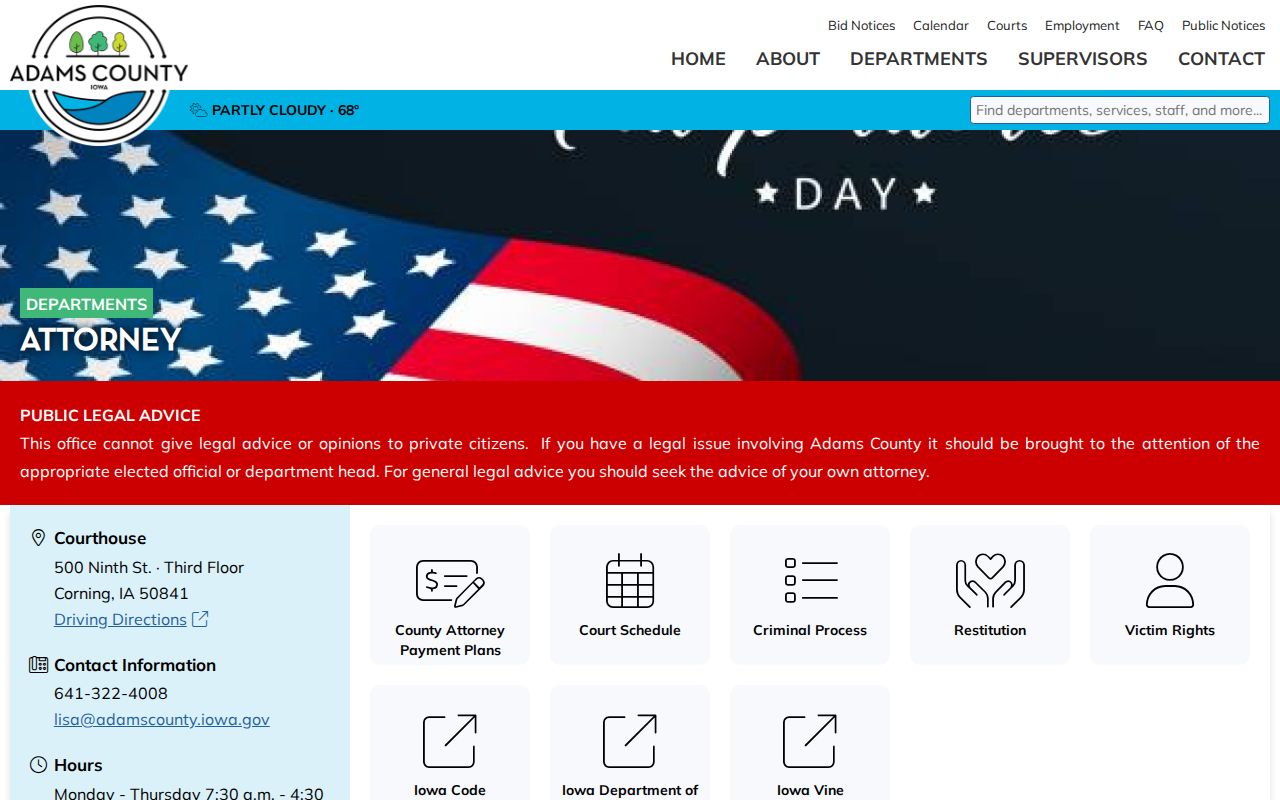
The office is on the third floor of the courthouse and can be reached at 641-322-4008, while filed court records remain with the Clerk of District Court.
Victim-rights and restitution work may create public docket events, yet protected victim details can still be redacted. Read the court's public entry for the procedural result and ask the proper office only for information it may lawfully release.